You might not know the name Michael P. Fay. He was the American kid who got caned in Singapore and shot to fame as the US government tried literally to save his ass. The US government managed to reduce his pain by 1/3, he took 4 instead of 6 cane strokes and got a Wikipedia entry for that.
Foreigners never learn from this incident and all the "Caning" T-shirts sold in souvenir shops. The Singaporean government is trying to extradite a Brit for vandalizing an underground train with another Swiss who was already caught. Vandalism in Singapore can carry a fine of nearly £1,000 or three years in jail and three to eight strokes of a cane.
http://news.bbc.co.uk/2/hi/uk/10261955.stm
The graffiti was so professionally done that initially the underground staff took no notice and thought it was officially sanctioned!!
Thursday, June 10, 2010


Tuesday, June 8, 2010
X-ray Specs, spy pen camera and other gadgets
The 2-day university entrance examinations in China is underway and so far 6 groups of people have been arrested for selling exam-cheating devices. Concealed walkie-talkie, embedded ear transmitters, spy pen camera, ruler with hidden display, etc, etc have been confiscated. With the end of the cold war, this is perhaps the biggest single drive for surveillance devices. And in order to catch potential cheats, the education authority employs security professionals to monitor exam hall covered with CCTVs, signal jamming devices and other anti-surveillance measures.
Cheating used to be a shameful act frowned upon by parents but in the twisted social values in China, parents are often condone such acts and even participate in the act by feeding answers to their sons inside the exam halls through the wireless devices. For an example of local coverage of the matter, see the link in Chinese below:
http://paper.wenweipo.com/2010/06/08/CH1006080001.htm
Of course, it's not just written examination where they cheated. Earlier this year, students cheated in marathon because the result formed part of the education credits.
http://www.huffingtonpost.com/2010/01/21/dozens-cheat-in-xiamen-ch_n_432444.html
But physically taking the exam even without the need to study maybe too much hard work for some, by paying a fee of RMB 8,000, you can guarantee yourself a qualifying score for university entrance. You might think that such services would only be available in some back-alley shop where you walk through a small door guarded by a guy with a turban. You slip a stash of cash into an unmarked envelop and pass to the old man behind the counter. He would tell you not to worry about the exam result. You are wrong!! You can find such services openly advertised on the web and you can even pay by credit cards. It is so institutionalized that such services are offered for a large range of exams.
http://www.jy87888.com/index.asp

In China, you can never be sure if what you are buying will actually work. In the desperate pursuit to succeed, you might fall prey to charlatans promising the world in exam results or sell you gadgets purport to do everything. But you have no legal recourse in the event that none of these work. Perhaps the only solution in China is to be born in a family with all the right connections.

Stop Press: Instead of enduring the mad struggle to get a university entrance, fake graduation certificates solve the problem. You can get those issued by Beijing University or Qinghua University for RMB 400 under your name and for whatever subject you care to name, even if the subject is not being offered by the university (a bit like the fake Cartier watches with features not found in the original). You can refer to the original article in Oriental Daily for more details and photos.
http://orientaldaily.on.cc/cnt/news/20100609/00176_005.html?pubdate=20100609
Cheating used to be a shameful act frowned upon by parents but in the twisted social values in China, parents are often condone such acts and even participate in the act by feeding answers to their sons inside the exam halls through the wireless devices. For an example of local coverage of the matter, see the link in Chinese below:
http://paper.wenweipo.com/2010/06/08/CH1006080001.htm
Of course, it's not just written examination where they cheated. Earlier this year, students cheated in marathon because the result formed part of the education credits.
http://www.huffingtonpost.com/2010/01/21/dozens-cheat-in-xiamen-ch_n_432444.html
But physically taking the exam even without the need to study maybe too much hard work for some, by paying a fee of RMB 8,000, you can guarantee yourself a qualifying score for university entrance. You might think that such services would only be available in some back-alley shop where you walk through a small door guarded by a guy with a turban. You slip a stash of cash into an unmarked envelop and pass to the old man behind the counter. He would tell you not to worry about the exam result. You are wrong!! You can find such services openly advertised on the web and you can even pay by credit cards. It is so institutionalized that such services are offered for a large range of exams.
http://www.jy87888.com/index.asp

In China, you can never be sure if what you are buying will actually work. In the desperate pursuit to succeed, you might fall prey to charlatans promising the world in exam results or sell you gadgets purport to do everything. But you have no legal recourse in the event that none of these work. Perhaps the only solution in China is to be born in a family with all the right connections.
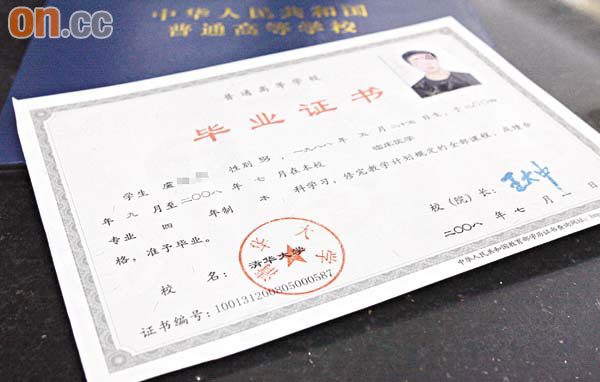
Stop Press: Instead of enduring the mad struggle to get a university entrance, fake graduation certificates solve the problem. You can get those issued by Beijing University or Qinghua University for RMB 400 under your name and for whatever subject you care to name, even if the subject is not being offered by the university (a bit like the fake Cartier watches with features not found in the original). You can refer to the original article in Oriental Daily for more details and photos.
http://orientaldaily.on.cc/cnt/news/20100609/00176_005.html?pubdate=20100609
Tuesday, June 1, 2010
Hoover and Mop
A few years ago, auntie R sent us this card.

And now she added this video clip to the collection.

And now she added this video clip to the collection.
Thursday, May 27, 2010
HK Art Fair 2010

Dionisio Gonzalez - Nova Aqua Gagosa II 2008 - a blend of photos from slumps and modern, geometric architecture

Yoshitomo Nara - Sleepless night 2007 - limited edition of 300

David Nash - not sure about the name of this, but doesn't it remind you of the Twin Towers in New York?

Yoshitomo Nara - Your Dog 2003

Familiar style from a gallery near Hollywood Road

This may give you the creeps!!
Tuesday, May 18, 2010
Cappuccino

This simple cup of cappuccino never fails to amaze us. From the different layers of colors, the complex coffee fragrance and even the way milk is frothed.
The other day, dad tried frothing a bottle of fresh milk and it came out completely flat. The first thought was the bottle of milk went bad. That tasted perfect. Creamy and cold, yum!! Only then did dad remember that full fat foams, though fuller in texture and flavor, are much much more difficult to make. Of course, he never had any problems using UHT full fat milk to froth before, since those are never very creamy.
You might be surprised to hear that the scorching hot steam coming out of the steam nozzle on an espresso machine is not an essential ingredient of the cappuccino milk foam. In fact, one can argue that the steam is detrimental to the formation and maintenance of the milk foam. The foam is formed by splashing milk and air together and the steam is just an agent in the process. The resulting water vapor or the condensed water are bad because the foam bubble wall becomes runny and prone to collapse if it is hot and has high water content. Hence frothing is best done with a lot of ice cold milk and the nozzle is only placed just below the milk surface.
Given that the hot steam is not an essential part of frothing but splashing the milk is, there are devices that splash milk mechanically, like the Nespresso Aeroccino. Since high temperature is bad for holding the bubbles, you can even have cold milk foam for cold drinks.
For those of you who want to know why full fat milk is tough to froth into foam, you might want to look up whey proteins, which are essential in stabilizing milk foams and ice crystals in ice creams. It also plays an essential part in body building.

Monday, May 17, 2010
泗益 Si Yik - Hong Kong Style French Toast

 After the Eve Felder cooking class mum had in Tai Tam, mum and dad went to their favorite french toast "dai pai dong" in Stanley. 泗益 Si Yik occupies one of the most conspicuous position within Stanley being just off the round-about going into Stanley High Street. It's a tiny stall selling the whole selection of dishes that you would normally expect from a “cha chaan teng", 茶餐廳.
They ordered two cold "yuanyang", 鴛鴦 and the french toast.


Thursday, May 6, 2010
What the Dog saw - by Malcom Gladwell
Would you buy a printed book whose content you can download legally in entirety from the internet? Before buying the printed version of "What the Dog saw", you need to ask that exact question. Of course dad bought his before he knew of such option, as both the front and back cover of the book never mentioned the fact it was a collection of past articles from the New Worker magazine and all these archived articles are available at Malcolm Gladwell's own website: http://www.gladwell.com/.
But even with this useful hindsight, dad would still recommend buying this compendium of articles. It saves you time in retrieving them individually from the internet and then printing them out. He would even argue that it's a better buy then Gladwell's other more famous works Blink, Tipping Point and Outliers, where Gladwell expand an underlying, simple thesis into an entire book.
Blink - trust your gut instinct once you have practiced something for long enough
Tipping Point - exponential increases in activities are often triggered by some events that will be obvious only in hindsight
Outliers - exceptional successes take place under exceptional (lucky?!) timing and inordinate amount of hard work
"What the Dog Saw", in contrast, covered a broad spectrum of topics often with brilliant insights. If you like Freakonomics and Super Freakonomics, you will definitely like this book. Our favorite articles are the following for obvious reasons:
Troublemakers - What Pit Bulls Can Teach Us About Crime
What the Dog Saw - Ceasar Millan and the Movements of Mastery
The Ketchup Connundrum - Mustard Now Comes in Dozens of Varieties. Why has Ketchup Stayed the Same?
But even with this useful hindsight, dad would still recommend buying this compendium of articles. It saves you time in retrieving them individually from the internet and then printing them out. He would even argue that it's a better buy then Gladwell's other more famous works Blink, Tipping Point and Outliers, where Gladwell expand an underlying, simple thesis into an entire book.
Blink - trust your gut instinct once you have practiced something for long enough
Tipping Point - exponential increases in activities are often triggered by some events that will be obvious only in hindsight
Outliers - exceptional successes take place under exceptional (lucky?!) timing and inordinate amount of hard work
"What the Dog Saw", in contrast, covered a broad spectrum of topics often with brilliant insights. If you like Freakonomics and Super Freakonomics, you will definitely like this book. Our favorite articles are the following for obvious reasons:
Troublemakers - What Pit Bulls Can Teach Us About Crime
What the Dog Saw - Ceasar Millan and the Movements of Mastery
The Ketchup Connundrum - Mustard Now Comes in Dozens of Varieties. Why has Ketchup Stayed the Same?
Wednesday, May 5, 2010
Special license plate "5*X 542"


High Tea in the Shangri La Hong Kong
 People in Hong Kong often plan their holidays months in advance, so that they can all meet up in the crowded airport, only to find out the neighbor next door is staying in the same resort. So during long holidays, Hong Kong suddenly becomes hospitable again. Driving through the central cross harbor tunnel at 9:00pm feels like driving through traffic at early hours in the morning, unlike Japanese who decide to venture out of their homes to face the crowded roads during the long golden week (GW) break.
Alas, if a quiet time enjoying some afternoon tea is all you are looking for during your holiday, you can do worse than staying put in Hong Kong.

A few good noodles
Today, the free Chinese newspaper am730 ran a double-page spread special on the Japanese noodle culture with 2 articles: one written by a Chinese and one written by a Japanese who is fluent in Chinese. The special has some interesting photos and the 2 articles are both well written. And it provides the perfect opportunity for us to talk about a few noodle places in Hong Kong.
Inaniwa Udon Nabe
 Situated at one of the quieter corners in the Elements shopping mall in Tsim Sha Tsui, the deceptively small shop front opened up to a spacious restaurant with high ceiling. Well past lunch time during a Saturday, most of the tables were still occupied. Despite the restaurant being quite full, it didn't feel crowded, perhaps helped by the high ceiling and the way tables were spaced out. The menu was simple: a few hot dish selections, udon accompanied by separate bowls of different sauces or soup (Tsuke udon つけうどん) and Japanese hotpot (nabe 鍋).
If you want to know more about tsuke udon, especially in relation to Inaniwa udon nabe, there is a fairly detailed discourse in openrice.com with the link as attached here. But as explained in the am730 article today, "tsuke" noodle was first developed for "ramen" in Tokyo in 1955 and it is still mainly a way reserved for serving "ramen". Wikipedia article in Japanese here.
Suffice to say, this shop made a damn good bowl of Japanese udon. But then if you follow the cooking instructions of the udon you get from Japanese stores here, you should get a decent shot of making a good bowl of cold udon as well. Guess the harder part is to get the sauce or the soup right.
The surprise was actually the sausage which came twirling inside a sizzling hot plate. Well worth going just for that. Delicious!!

Shop 2002, 2/F, Elements, 1 Austin Road West, Tsim Sha Tsui
尖沙 咀柯士甸道西1號圓方(Elements)2樓2002號舖
一碗麵
 HKD150 for a bowl of noodles. This was the most expensive bowl of beef noodles that dad has ever eaten. Situated at the crossing between Star Street and St Francis Street, an open-kitchen style interior with simple wooden tables and benches, this shop offered a very limited menu: noodles with 3 choices of soup (all HKD150) a few snacks and desserts. If it was a blind tasting, dad would never have guessed the price. In Hong Kong, there is enough clientele who would equate a high price to delicious food for this shop to carry on thriving.
G/F, St Francis Street 33, Wanchai. Tel: 22940426
鼎泰豐 Ding Tai Fung
 While super famous for its soup-filled xiao long bao 小籠包, its chicken soup noodle is well worth trying. Somehow the chicken soup tastes the same no matter where in the world you order. The only problem is waiting for a table.

麥兆記 Mak Siu Kee Wonton Noodle
Perhaps the best traditional thin egg noodle in Hong Kong. You can feel the "bounce" on the noodles. But the wonton 雲吞 here are not as good, but the beef tendon and brisket in chu hua sauce is very tasty. Photos to follow, if we get them.
Electric Road 74B, Tin Hau.
香港鏡記粉麵廠
If you fancy making your own wonton noodle, you can get fresh wonton skin and fresh egg noodles here. Photos and recipes to follow.
G/F, Tai Wo St 4, Wanchai.
Inaniwa Udon Nabe

If you want to know more about tsuke udon, especially in relation to Inaniwa udon nabe, there is a fairly detailed discourse in openrice.com with the link as attached here. But as explained in the am730 article today, "tsuke" noodle was first developed for "ramen" in Tokyo in 1955 and it is still mainly a way reserved for serving "ramen". Wikipedia article in Japanese here.
Suffice to say, this shop made a damn good bowl of Japanese udon. But then if you follow the cooking instructions of the udon you get from Japanese stores here, you should get a decent shot of making a good bowl of cold udon as well. Guess the harder part is to get the sauce or the soup right.
The surprise was actually the sausage which came twirling inside a sizzling hot plate. Well worth going just for that. Delicious!!

Shop 2002, 2/F, Elements, 1 Austin Road West, Tsim Sha Tsui
尖沙 咀柯士甸道西1號圓方(Elements)2樓2002號舖
一碗麵

G/F, St Francis Street 33, Wanchai. Tel: 22940426
鼎泰豐 Ding Tai Fung


麥兆記 Mak Siu Kee Wonton Noodle
Perhaps the best traditional thin egg noodle in Hong Kong. You can feel the "bounce" on the noodles. But the wonton 雲吞 here are not as good, but the beef tendon and brisket in chu hua sauce is very tasty. Photos to follow, if we get them.
Electric Road 74B, Tin Hau.
香港鏡記粉麵廠
If you fancy making your own wonton noodle, you can get fresh wonton skin and fresh egg noodles here. Photos and recipes to follow.
G/F, Tai Wo St 4, Wanchai.
Friday, April 30, 2010
樹記鮮竹 - the Mecca of tofu skin in Hong Kong


 Mum and dad have always tried replicating the pan-fried yuba 湯葉 they had in Kyoto by buying packet tofu skin from the supermarket. They never tasted the same, until they tried frying their latest purchase. All you need is a shallow frying pan where you heat up a bit of your favorite cooking oil, fry the tofu skin in low heat until golden brown. The crispy exterior contrasts nicely with the flavorful, soft interior. The secret is all in the fresh tofu skin.
The shop turned out to be featured in an old article in 飲食男女.

Excuse me, where's the shopping paradise please?
Dad often tells us that Hong Kong used to be known as a shopper's paradise. He is probably talking about when our great-great-grand father was still living in the US, ie over 20 years ago, when Hong Kong kids would go to UK boarding schools with their latest models of Walkman and be the envy of all the other boarders. So what happened in the interim years? Both the rise of China as a global export power and the spread of internet have brought down the price in so many things across the globe. Somehow that does not apply to Hong Kong.
Lets just take the water filter we drink from at home as an example. The water filter that comes inside our Samsung fridge costs HK$400, but you can buy 2 for US$65 inclusive of shipping (~HK$255 each) in the US. Not only is the price more expensive and sometimes you might need to wait over 3 to 4 months after you order the item having paid for it in the first place. "We have the water filter in stock now. You might want to order a few extra. The next shipment may not be for another 6 months!!", the customer service assistant so kindly advise when dad called up to check price and availability. The same item ordered in the US was dispatched within 24 hours.
Guess this is nothing new to all the people who have been shopping online for the last few years. But a lot of online retailers insist on domestic delivery only, notably in Japan and the US. That is where package forwarding services like MyUS.com come in. You sign up and pay an annual fee to get a mailing address where all your online purchases in the US can be sent to.
The following 2 water filter replacements are also great value when bought online. In Hong Kong, you pay the US RRP but you can find US domestic online retailers selling them at significant discount to RRP.
And there are even more extreme cases where people happily pay premium to US RRP for goods which are essentially the same. If mum and dad eventually acquire the item online, we might talk about it here. Until then......
Lets just take the water filter we drink from at home as an example. The water filter that comes inside our Samsung fridge costs HK$400, but you can buy 2 for US$65 inclusive of shipping (~HK$255 each) in the US. Not only is the price more expensive and sometimes you might need to wait over 3 to 4 months after you order the item having paid for it in the first place. "We have the water filter in stock now. You might want to order a few extra. The next shipment may not be for another 6 months!!", the customer service assistant so kindly advise when dad called up to check price and availability. The same item ordered in the US was dispatched within 24 hours.
Guess this is nothing new to all the people who have been shopping online for the last few years. But a lot of online retailers insist on domestic delivery only, notably in Japan and the US. That is where package forwarding services like MyUS.com come in. You sign up and pay an annual fee to get a mailing address where all your online purchases in the US can be sent to.
The following 2 water filter replacements are also great value when bought online. In Hong Kong, you pay the US RRP but you can find US domestic online retailers selling them at significant discount to RRP.
And there are even more extreme cases where people happily pay premium to US RRP for goods which are essentially the same. If mum and dad eventually acquire the item online, we might talk about it here. Until then......
Monday, April 19, 2010
Capital Cafe in Wanchai 灣仔 華星冰室


Uniquely Chinese - Shanghai Expo Song
http://www.youtube.com/watch?v=ggTMfIQoTp8
http://http://www.youtube.com/watch?v=eHgQXGUf2m0
http://search.japantimes.co.jp/cgi-bin/nn20100419a6.html
More news broadcasts in YouTube
http://www.youtube.com/watch?v=EjBhxaDLkjY
Update
The organizers of the 2010 World Expo in Shanghai have asked Japanese singer-songwriter Mayo Okamoto for permission to use one of her songs, which a Chinese composer had been accused of plagiarizing, in its promotional activities.
http://www.japantoday.com/category/entertainment/view/shanghai-expo-to-use-japanese-singers-song-for-promotion
日本語バージョン
http://www.yomiuri.co.jp/world/news/20100419-OYT1T01132.htm
http://http://www.youtube.com/watch?v=eHgQXGUf2m0
http://search.japantimes.co.jp/cgi-bin/nn20100419a6.html
More news broadcasts in YouTube
http://www.youtube.com/watch?v=EjBhxaDLkjY
Update
The organizers of the 2010 World Expo in Shanghai have asked Japanese singer-songwriter Mayo Okamoto for permission to use one of her songs, which a Chinese composer had been accused of plagiarizing, in its promotional activities.
http://www.japantoday.com/category/entertainment/view/shanghai-expo-to-use-japanese-singers-song-for-promotion
日本語バージョン
http://www.yomiuri.co.jp/world/news/20100419-OYT1T01132.htm
Our very own Susan Boyle
Auntie Rita sent us this YouTube clip a few days ago. We shall let the clip do the talking!!
http://www.youtube.com/watch?v=0233fqfr7mo
http://www.youtube.com/watch?v=0233fqfr7mo
Subscribe to:
Posts (Atom)